Description
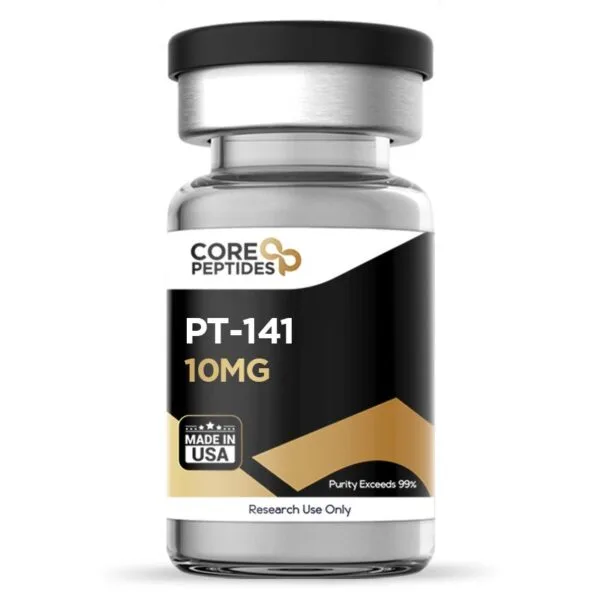
PT-141 Peptide (Bremelanotide) – Overview & Mechanism
PT-141, also known as Bremelanotide, is a synthetic cyclic peptide made up of seven amino acids. Researchers classify it as a melanocortin receptor agonist because it interacts with receptors similar to the natural hormone alpha-MSH. Scientists also identify it as a metabolite of melanotan II.
Studies suggest that melanocortin hormones regulate several physiological functions. As a result, researchers continue to explore PT-141 for its potential effects, especially in relation to reproductive function and central nervous system activity.
Mechanism of Action of PT-141 Peptide
Researchers believe that PT-141 activates melanocortin receptors, particularly MC3R and MC4R. These receptors exist mainly in the brain, especially in the hypothalamus.
MC3R appears to support energy balance and metabolic regulation. It may also influence appetite and feeding behavior. In addition, some studies suggest that MC3R helps regulate glucose and lipid metabolism.
On the other hand, MC4R plays a major role in appetite control and energy expenditure. When activated, it may increase energy output and support metabolic activity. Furthermore, researchers link MC4R to reproductive function and behavioral responses.
Because PT-141 interacts with these receptors, it may stimulate neurons in the hypothalamus. This interaction could lead to increased neural activity and signaling in the central nervous system.
PT-141 and Central Nervous System Activity
PT-141 primarily acts on the brain rather than directly on peripheral tissues. Researchers have studied its effects in several brain regions, including the hypothalamus and medial preoptic area (mPOA).
In animal studies, PT-141 increased behavioral responses related to motivation and interest. However, it did not significantly alter general movement or physical activity. This suggests that the peptide may target specific neural pathways instead of causing broad stimulation.
Additionally, researchers propose that PT-141 may activate dopamine pathways in the brain. This activity could influence behavioral responses and neural signaling. However, further studies are needed to confirm these mechanisms. You may also be interested in our related research peptides, including GHRP 2 Peptide, Fragment 176-191, Follistatin 344, LL-37 Peptide, Melanotan 2 Peptide, CJC-1295 DAC Peptide, Adipotide Peptide, MGF peptide, PEG-MGF Peptide, and Vilon Peptide.
PT-141 Peptide and Arousal Research
Scientists have also explored PT-141 for its potential role in physiological arousal. Research suggests that activation of MC4R may influence nitric oxide (NO) production. This process may affect vascular responses in certain tissues.
In experimental models, melanocortin receptor activation increased pressure responses in specific tissues. However, when researchers blocked these receptors, the effects were reduced or eliminated. This finding highlights the importance of melanocortin pathways in these processes.
Moreover, studies indicate that neural signaling plays a key role. When researchers inhibited nerve pathways or nitric oxide synthesis, the observed effects decreased. Therefore, PT-141 likely works through central nervous system signaling rather than direct tissue action.
Research Findings and Behavioral Studies
Early studies focused on how PT-141 influences behavior in animal models. Researchers observed increased behavioral responses without major changes in physical movement. This suggests that the peptide may selectively affect motivation-related pathways.
In more advanced studies, researchers used neuroimaging and hormonal analysis. These studies showed that melanocortin receptor activation may increase brain activity in specific regions. For example, activity increased in motor and emotional processing areas when subjects were exposed to stimuli.
At the same time, some sensory regions showed reduced activity. Researchers also observed stronger connections between key brain regions involved in emotional and behavioral responses. These findings suggest that PT-141 may influence how the brain processes certain stimuli.
PT-141 Chemical Profile
-
Molecular Formula: C₅₀H₆₈N₁₄O₁₀
-
Molecular Weight: 1025.18 g/mol
-
Other Name: Bremelanotide
Summary of PT-141 Peptide
PT-141 (Bremelanotide) is a synthetic peptide that targets melanocortin receptors in the brain. Researchers study it for its potential effects on neural activity, metabolism, and behavioral responses.
Because it acts primarily through the central nervous system, it may influence specific signaling pathways rather than general physical activity. While current research provides valuable insights, further studies are still needed to fully understand its mechanisms and potential applications.



Reviews
There are no reviews yet