Description
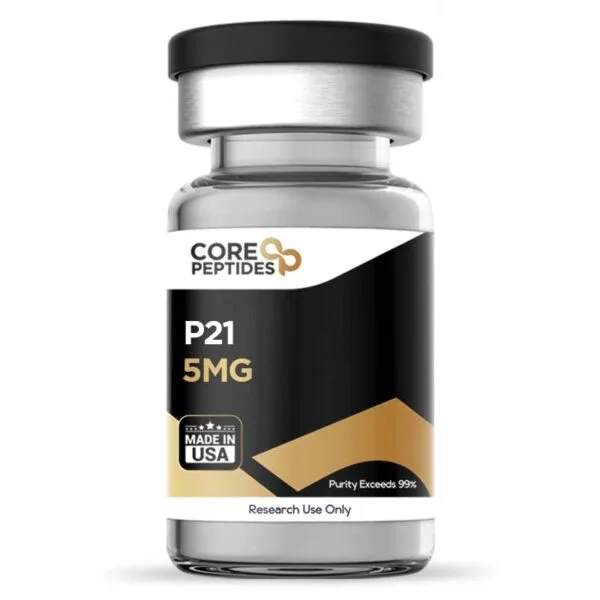
P21 Peptide
The P21 (also identified as P021) is a synthetic peptide designed to mimic the activity of ciliary neurotrophic factor (CNTF) on the brain without triggering an allergic response. CNTF is a protein that promotes the survival and differentiation of various neural cells, including neurons and oligodendrocytes. CNTF has been suggested to exhibit possible neuroprotective and neurodegenerative activity in animal models of neurodegenerative diseases and injuries. Scientists identified CNTF’s most active regions based on epitope mapping of neutralizing antibodies to CNTF.(1) This led to the development of Peptide 6, made of 11 amino acids (Ac-VGDGGLFEKKL-NH(2)) and a subsequence of just 4 amino acids called Peptide 6c (Ac-DGGL-NH(2)).
These amino acids have been theorized to support hippocampus-dependent learning and memory, increase neurogenesis, and potentially boost neuronal plasticity, as posited in murine models. To improve the stability of the peptide and boost its potential to pass through the blood-brain barrier, the scientists report that they “added adamantane building blocks to the C-terminus or both C- and N-termini of Peptide 6c.” The result is P21, which appears to have the potential to mimic the action of CNTF by activating the CNTF receptor complex and downstream signaling pathways, possibly leading to enhanced cognition, increased proliferation, and neuronal differentiation of adult hippocampal progenitors in murine models.
Chemical Makeup
Molecular Formula:C30H54N6O5
Molecular Weight: 578.3 g/mol
Sequence: Ac-DGGL-adamatanylglycine-NH2
Other Known Titles: P021
Research and Clinical Studies
P21 Peptide and Cognitive impairment
P21 has been extensively researched in experimental models of cognitive impairment. One notable study examined the impact of P21 peptide exposure in 3xTg-AD murine models between 6-9 months prior to the onset of amyloid beta (Aβ) or tau pathology and during the period of synaptic compensation.(2) The study suggested that P21 appeared to rescue dendritic and synaptic deficits, boost neurogenesis, and reverse cognitive impairment in the 3xTg-AD murine models. The study suggests that P21 may contribute to the mitigation of synaptic deficits and cognitive impairment by potentially providing neurotrophic support during synaptic compensation. According to the researchers, this potential may be achieved via the proposed influence of the peptide on synaptic plasticity, as the peptide appears to increase the levels of several markers essential for synaptic function, such as synapsin, PSD-95, and MAP2. Synapsin may regulate neurotransmitter release, which is considered crucial for communication between neurons. PSD-95 is posited to organize components within postsynaptic densities, ensuring signals are received and processed at synaptic junctions. MAP2 is thought to stabilize microtubules in dendrites, supporting their structure and possibly influencing the formation and maintenance of synaptic connections. Overall, these proteins may support the regulation of neurotransmitter release, potentially stabilizing synaptic changes and maintaining the structural integrity of dendrites. These are essentially nerve cell projections that may receive information from other neurons, called presynaptic neurons, or from the environment. By boosting these markers, P21 is posited to help preserve and enhance synaptic functionality.
Another study suggested that the P21 may reduce the natural decline in learning and memory in aged Fisher murine models by inhibiting neurogenesis deficit and possibly increasing the expression of brain-derived neurotrophic factor (BDNF) and restoring synaptic deficits in the cortex and hippocampus.(3) BDNF is posited to be a key protein in the survival and differentiation of neurons and the growth of dendrites. BDNF may work by activating pathways that may prevent cell death and promote the differentiation of progenitor cells into mature neurons, especially in the hippocampus, which may aid in ongoing neurogenesis. BDNF is also thought to be instrumental in enhancing synaptic plasticity. It may help strengthen synaptic connections and modulate neurotransmitter release, facilitating better cognition in models of cognitive impairment. BDNF may also contribute to the structural complexity of neurons by encouraging the growth and branching of dendrites, thereby increasing neural connectivity. The study also indicated that P21 appeared to reduce the concentration of myoinositol, a metabolite that naturally increases in murine models. The study suggests that “stimulating endogenous neuroprotective mechanisms using P21 may be [an interesting research] approach for cognitive aging, Alzheimer’s disease, and associated neurodegenerative disorders.”
P21 Peptide and Alzheimer’s Disease (AD) Models
Experiments are actively investigating the potential research outcomes of P21 in Alzheimer’s models. One study focusing on the potential of P21 suggested that chronic exposure of P21 appeared to possibly reduce the brain level of total tau in aged Fisher rats and possibly also reduce tau levels in the cerebrospinal fluid (CSF) to that of young adult rats.(4) The study also observed that “P21 [may be] blood-brain-barrier-permeable and [may] not induce any detectable immune reaction.” The exact mechanism for the apparent reduction of tau protein levels remains unknown. Yet, the researchers posit that the increased BDNF activity may modulate downstream effectors such as glycogen synthase kinase-3 (GSK-3). GSK-3 is posited to be a kinase involved in the phosphorylation of tau. Phosphorylated tau is prone to aggregation, forming neurofibrillary tangles, a hallmark of Alzheimer’s (AD) models. By modulating BDNF levels, P21 may indirectly inhibit GSK-3 activity, potentially reducing tau phosphorylation.
Another study investigated the potential of P21 on neurobehavior and AD-like pathology in a transgenic murine model of AD.(5) The compound was presented during the mice’s prenatal to early postnatal development. Results suggested that the peptide appeared to rescue cognitive deficits, reduce abnormal accumulation of tau and Aβ plaque load, ameliorate certain markers of postsynaptic deficits, and decrease neuroinflammation in the brain. The purported mechanism may have involved improving PSD-95 levels and cAMP response element-binding protein (CREB) activity, which are considered markers of synaptic function and memory formation. Additionally, P21 may have reduced glial fibrillary acidic protein (GFAP) levels, indicating a potential decrease in neuroinflammation.
In another experiment, the researchers investigated the neurotrophic potential of the P21 compound in preventing neurodegeneration, amyloid-β, and tau pathologies in 3xTg-AD murine models.(6) The researchers started P21 exposure during the period of synaptic compensation several months before the appearance of any overt pathology. They observed that P21 initiated during this period might have prevented neurodegeneration, Aβ, and tau pathologies, rescued episodic memory impairment, and may have potentially reduced the mortality rate.
One trial also investigated the potential of P21 on cognitive function and synaptic plasticity in a transgenic murine model of AD.(7) Results indicated that the peptide might mitigate cognitive impairment, increase expressions of pCREB and BDNF, and ameliorate synaptic protein deficit in the murine models. These actions may lead to the activation of three key signaling pathways: PLC/PKC, MEK/ERK, and PI3K/Akt. These pathways are purported to play a potential role in neuronal survival, growth, and synaptic plasticity. By enhancing these signaling cascades, the peptide is posited to improve synaptic protein expression. The study also suggests that P21 might potentially rescue synaptic deficits and cognitive impairment in familial AD and related tauopathies during early development.
P21 Peptide and Macular Degeneration
Age-related macular degeneration (AMD) affects the macula, the central part of the retina responsible for central vision. It is considered a common neurodegenerative disease that may lead to vision loss at its end stage. Recent research has suggested that consistent exposure to the neurotrophic peptidergic compound may help prevent the occurrence of AMD pathology.
A study conducted in aged and 3xTg-AD murine models reported that chronic presentation of P21 appeared to possibly prevent several pathological changes associated with AMD.(8) The study reported identifying photoreceptor degeneration, lipofuscin granules, vacuoles, atrophy in retinal pigment epithelium (RPE), and Bruch’s membrane (BM) thickening. The study also reported a rosette-like structure formation in aged murine models, a hallmark of AMD pathology. Microgliosis and astrogliosis, inflammatory responses in the retina, were also observed in different retinal layers. Furthermore, the study indicated that total tau, phosphorylated tau, Aβ/APP, and VEGF appeared widely distributed in the sub-retina of aged and 3xTg murine models. These molecules are associated with Alzheimer’s disease pathology, and their presence suggests that retinal changes associated with aging and Alzheimer’s disease may share some common features. Importantly, consistent exposure to P21 for three months in rats and 18 months in 3xTg murine models appeared to ameliorate the pathological changes described above. You may also be interested in our related research peptides, including: ghrp 2 peptide, fragment 176-191, Follistatin 344, LL-37 Peptide, Melanotan 2 Peptide, CJC-1295 DAC Peptide, Adipotide Peptide, MGF peptide, PEG-MGF Peptide ,Vilon Peptide.

Hallie Tyler (Verified Purchase) –
P21 (5mg) has been a great addition to my routine. I’ve noticed sharper focus and improved memory over time. Payment through Bitcoin was fast and secure, and shipping arrived right on schedule. Very satisfied with the overall experience.
Richard Barton (Verified Purchase) –
This peptide seems to support better concentration and clarity. After a few weeks, I felt more mentally alert. Used CashApp for payment, which was smooth. Packaging was professional and delivery was quick.
Aron Marsh (Verified Purchase) –
P21 looks well-made and consistent. Effects on cognition and memory feel promising. Zelle payment worked seamlessly, and delivery was fast. Definitely a reliable option for research purposes.
Kimberley Bonner (Verified Purchase) –
I’ve experienced better recall and focus since using P21. It seems to support cognitive function well. Bitcoin payment was easy and secure, and the product arrived in perfect condition.
Sasha Winter (Verified Purchase) –
P21 works, but the effects took longer than expected to notice. Some improvement in focus and memory though. Paid via CashApp without issues. Overall, a decent experience.
Myla Harrington (Verified Purchase) –
This peptide delivers steady improvements in mental performance. I appreciate the consistent quality. Zelle payment was quick, and shipping was fast. Highly recommend it.
Muhammad Ellis (Verified Purchase) –
Saw mild improvements in memory and attention span. Not dramatic, but noticeable. CashApp payment was easy and secure. Worth trying if expectations are realistic.
Tiffany Wilkinson (Verified Purchase) –
Product arrived well-packaged and intact. P21 seems to enhance focus and clarity. Paid using Bitcoin, and the process was smooth. Great service overall.
Dana Bush (Verified Purchase) –
P21 has shown great potential in supporting cognitive sharpness. I feel more focused daily. Zelle payment was smooth, and shipping was timely. Very pleased.
Angela Allen (Verified Purchase) –
Quality and consistency stand out. Cognitive benefits are noticeable after consistent use. Bitcoin payment option is convenient, and delivery was fast.
Rex Koch (Verified Purchase) –
From ordering to delivery, everything was seamless. Paid with CashApp easily. P21 seems to support mental clarity and focus. Very happy with the purchase.
Kayleigh Powell (Verified Purchase) –
After some time, I noticed improved recall and mental sharpness. Zelle payment was fast and convenient. Shipping was also reliable. Will reorder.
Byron Baird (Verified Purchase) –
The peptide shows some benefits for cognition, but nothing extreme. Still useful over time. Bitcoin payment worked perfectly. Overall a fair product.
Frazer Kerr (Verified Purchase) –
P21 delivers consistent improvements in focus and clarity. Payment through CashApp was smooth. Packaging and delivery were also well handled.
Alina Holder (Verified Purchase) –
Memory retention feels better with continued use. This product seems promising. Zelle payment was quick and secure. Shipping was fast too.
Ciaran Espinoza (Verified Purchase) –
The product might be good, but shipping took longer than expected. Payment via Bitcoin was smooth, but the delay was disappointing. Needs better logistics.
Katrina House (Verified Purchase) –
Received the product with slight damage to packaging. Paid through CashApp with no issues, but handling needs improvement. Hoping quality inside is still intact.
Roy Webster (Verified Purchase) –
P21 seems reliable for cognitive support. I’ve noticed steady improvements. Zelle payment was fast, and delivery was on time. Great experience overall.
Rodney Wood (Verified Purchase) –
This peptide offers good potential for focus and memory support. Payment with Bitcoin was easy, and shipping was quick. Satisfied with the purchase.